







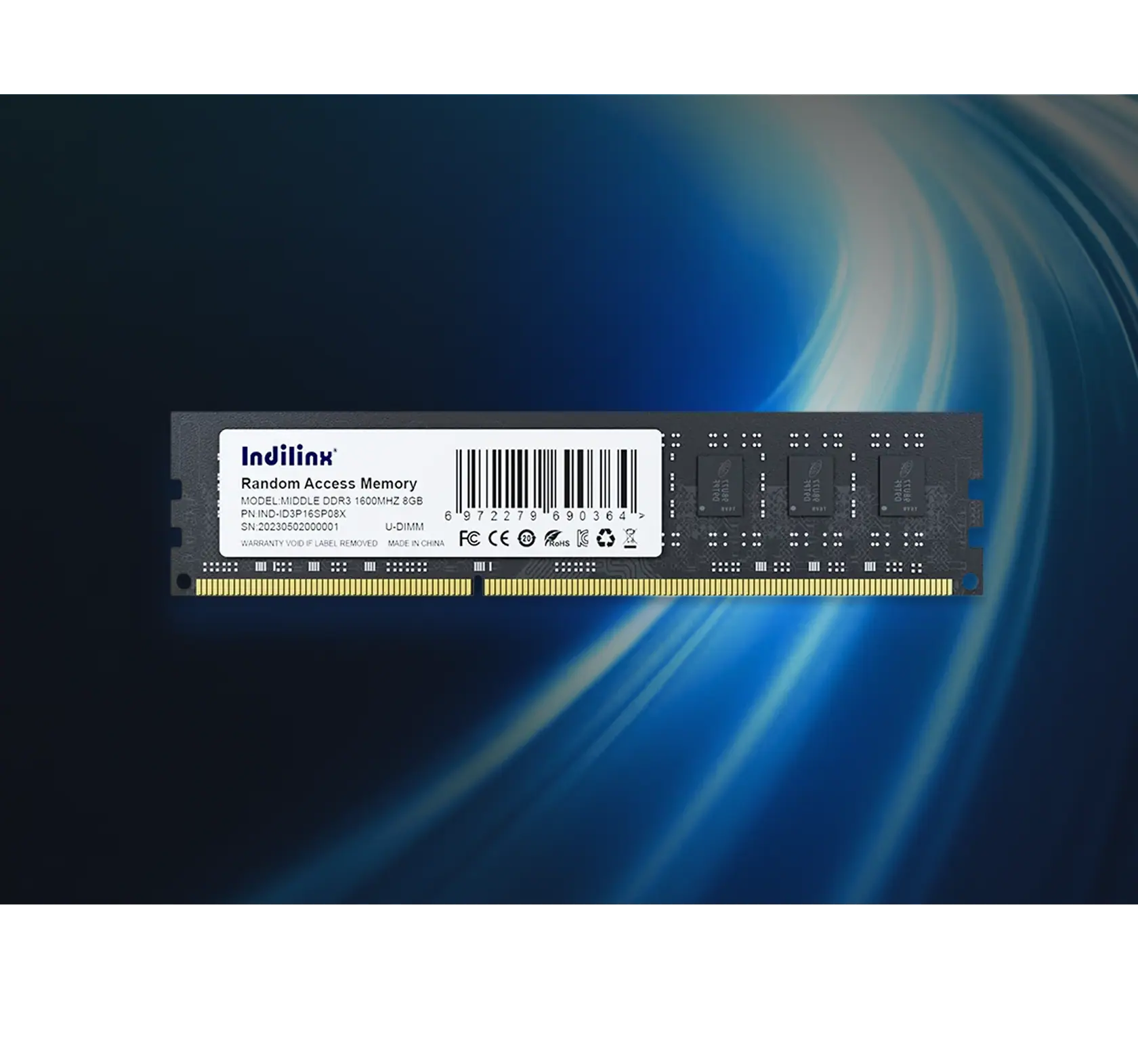
As the latest generation of CPU platforms fully embraces DDR5, many users face a common dilemma when building or upgrading their PCs: Is DDR4 still worth purchasing? Has DDR5 already become the optimal choice? This article provides a comprehensive comparison covering performance, power consumption, and compatibility to help you select the memory solution best suited to your needs.
What Are DDR4 and DDR5 Memory?
Before evaluating the choice between DDR4 and DDR5, it is essential to first clarify the fundamental definitions and technical positioning of both standards. While both fall under the “Double Data Rate (DDR)” memory standard, they represent distinct stages of evolution and exhibit significant differences in terms of performance, architecture, and application positioning.
Basic Definition and Characteristics of DDR4 Memory
DDR4 (Double Data Rate 4) is the fourth-generation double data rate memory standard and represents one of the mainstream memory types that evolved from its predecessor, DDR3.
From a technical standpoint, the core characteristics of DDR4 are “maturity and stability.” Its advantages are primarily reflected in the following areas:
- A long history of technical development and a well-established ecosystem
- Broad compatibility, supporting a vast number of existing platforms
- Performance capable of meeting the demands of mainstream office work and gaming
- Relatively lower cost, offering outstanding value for money
Consequently, DDR4 has long remained the mainstream choice for consumer-grade computers, making it suitable for most daily tasks and scenarios requiring moderate performance.
Basic Definition and Characteristics of DDR5 Memory
DDR5 (Double Data Rate 5) is the fifth-generation double data rate memory standard and represents the current latest generation of memory technology; it features systematic upgrades across multiple core dimensions compared to DDR4.
Its key characteristics include:
- Higher base frequencies and greater bandwidth
- Support for larger capacities per individual memory module
- A more advanced architectural design
- Enhanced capabilities for multitasking and handling heavy workloads
The design objective of DDR5 goes beyond simply being “faster”; it is engineered to address higher data throughput and more complex computing environments, providing greater headroom for expansion in high-performance computing and future applications.
Positional Differences Between DDR4 and DDR5
From a holistic perspective regarding their market positioning, the differences between the two can be summarized as follows:
- DDR4:Mature and stable; targeted at the mainstream and value-oriented market segments.
- DDR5:High-performance and future-oriented; targeted at heavy-workload scenarios and new computing platforms.
In other words, DDR4 leans more toward being “sufficient and stable,” while DDR5 leans more toward offering “higher performance and greater scalability.”
This distinction implies that the relationship between the two is not merely one of simple substitution, but rather represents a choice between technical solutions tailored to different tiers of user requirements.
Fundamental Differences Between DDR4 and DDR5 Memory
DDR4 and DDR5 exhibit systemic differences in both architectural design and performance metrics. DDR5 features upgrades in frequency, bandwidth, capacity, and data reliability, whereas DDR4 distinguishes itself through its core strengths of maturity, stability, and high compatibility. The following parameter comparison offers a more intuitive understanding of the key distinctions between the two.
DDR4 vs. DDR5: Core Parameter Comparison Table
| Comparison Dimension | DDR4 | DDR5 |
| Memory Generation | 4th Generation DDR Standard | 5th Generation DDR Standard |
| Starting Frequency | Starts at approx. 2666MHz | Starts at 4800MHz |
| Typical Frequency Range | 2666MHz – 3600MHz | 4800MHz – Higher Frequency Extensions |
| Data Bandwidth | Approx. 20–25GB/s | Starts at approx. 38GB/s |
| Voltagem Operacional | 1.2V | 1,1V |
| Single-Module Capacity Support | Relatively Lower | Supports Higher Capacities |
| Architectural Design | Traditional Single-Channel Design | Dual-Channel Independent Sub-Channel Architecture |
| Error Correction Mechanism | No Built-in On-Die ECC | Supports On-Die ECC |
| Gerenciamento de Energia | Motherboard-Controlled Power Supply | Built-in PMIC (Power Management IC) |
| Stability Design | Mature and Stable Architecture | Stability Architecture Optimized for High Frequencies |
| RGB Support (Product Level) | Supports RGB Lighting Effects | Supports RGB Lighting Effects |
Summary of Core Differences
As evident from the parameter comparison, the upgrade to DDR5 is not merely a matter of “increased frequency,” but rather an optimization at the level of the entire architecture. This is primarily reflected in the following aspects:
- Performance: DDR5 enhances data throughput capabilities through higher frequencies and greater bandwidth.
- Architecture: Upgrades from a traditional design to a sub-channel structure capable of higher concurrent processing.
- Stability: Introduces On-Die ECC to improve data reliability.
- Power Consumption: Lowers operating voltage and optimizes power management efficiency.
- Scalability: Supports higher capacities, making it suitable for more complex application scenarios.
How Much Faster is DDR5 Than DDR4?
When comparing the speed differences between DDR4 and DDR5, one cannot rely solely on a single frequency value; instead, a comprehensive assessment is required that considers the actual operating frequency range, the method of performance delivery, and the platform’s optimization capabilities. DDR4 emphasizes stable operation and mature circuit optimization, whereas DDR5 achieves higher bandwidth and faster data processing capabilities through higher frequencies and XMP 3.0 technology.
DDR4: Real-World Operating Speeds and Stability Optimization
The mainstream operating frequencies for DDR4 typically cluster within ranges such as 2666MHz and 3200MHz—ranges that have undergone extensive platform validation and circuit optimization.
Its key characteristics include:
- Mature and stable frequency range (2666MHz–3200MHz is common)
- Optimized circuit design resulting in stable data access latency
- Excellent compatibility with desktop systems and gaming environments
- High stability during prolonged periods of operation
Core Positioning: DDR4 serves as a memory solution geared toward stable performance delivery and low-risk operation.
DDR5: High-Frequency Performance and XMP 3.0 Acceleration Capabilities
DDR5 targets users with higher performance demands; it features significantly increased base frequencies and utilizes XMP 3.0 technology to rapidly unlock its full performance potential.
Its core upgrades include:
- Pre-configured XMP 3.0 overclocking profiles
- One-click access to frequencies reaching up to 6000MT/s or even higher
- Higher bandwidth that significantly boosts data throughput capabilities
- Architectural design optimized for high-load applications
The direct results of these features are:
- Higher maximum frame rates (in gaming scenarios)
- Faster rendering speeds (for 3D and video processing)
- A smoother multitasking experience
Core Positioning: DDR5 is a performance-oriented memory solution designed to deliver high frequencies and high bandwidth.
The Essence of the Speed Difference: Not Just a “Frequency Comparison,” but a “Bandwidth Delivery Capability”
Many users tend to equate “speed improvement” solely with an increase in frequency; however, the fundamental shift with DDR5 lies not merely in frequency, but in its overall data throughput capability. It can be understood as follows:
- DDR4: Stable frequencies + Mature latency optimizations
- DDR5: High frequencies + High bandwidth + Rapid release mechanisms
The key distinction lies in this: DDR5’s advantage stems from its “sustained high-throughput capability,” rather than merely a single peak frequency value.
Speed Performance Across Different Scenarios
The actual speed difference between DDR4 and DDR5 varies depending on the usage scenario:
- Daily Office Work & Web Browsing: Differences are negligible.
- The actual speed difference between DDR4 and DDR5 varies depending on the usage scenario:
- Mainstream Gaming: Improvements are modest but offer greater stability.
- Competitive Gaming (CPU-bound scenarios): DDR5 offers a higher performance ceiling.
- 3D Rendering & Video Editing: DDR5 delivers significant performance gains.
- Multitasking: DDR5 encounters fewer performance bottlenecks.
Why DDR5 Often “Feels Faster
The experiential advantage of DDR5 is the result of several cumulative factors:
- Higher base frequencies
- Higher bandwidth ceiling
- XMP 3.0: One-click performance unlocking
- Better suitability for high-load parallel tasks
The experiential advantage of DDR5 is the result of several cumulative factors:
- Higher base frequencies
- Higher bandwidth ceiling
- XMP 3.0: One-click performance unlocking
- Better suitability for high-load parallel tasks
However, it is also important to note:
- Differences are limited in low-load scenarios.
- Latency has not decreased significantly in tandem with frequency increases.
Therefore, the conclusion is:DDR5 leans more toward providing “significant acceleration under high loads,” rather than delivering linear acceleration across all scenarios.
Summary
DDR4 operates within the 2666–3200MHz range, emphasizing stability and mature optimizations; DDR5 can easily unlock frequencies of 6000 MT/s and above via XMP 3.0, offering distinct advantages in terms of bandwidth and high-load performance.
Selection Logic:
- Priority on stability and cost-effectiveness → DDR4
- Priority on high-performance output and productivity needs → DDR5
The speed advantage of DDR5 is, in essence, the combined result of “higher frequencies + higher bandwidth + superior architectural capabilities”; this translates into a truly perceptible performance difference only within high-load scenarios.
Latency Comparison: DDR4 vs. DDR5
Within the framework of memory performance evaluation, latency is a core metric that is often oversimplified in its interpretation, yet possesses a complex and multifaceted impact in reality. Many users are accustomed to judging memory responsiveness solely based on the CAS Latency (CL) value; however, this approach suffers from significant limitations, as latency is not determined solely by timing parameters, but is also collectively influenced by frequency, architectural design, and the actual workload environment.
From a holistic perspective, the latency performance of DDR4 and DDR5 exhibits a distinct characteristic: while there are “pronounced differences in parameters,” the “gap in actual user experience is gradually converging.” Consequently, a comprehensive analysis spanning multiple dimensions is required, rather than relying on a single metric to form a judgment.
Comparison of CAS Latency (CL) Values
At the level of fundamental parameters, a clear disparity exists between the CAS Latency of DDR4 and DDR5:
- DDR4: The mainstream range typically falls between CL14 and CL18.
- DDR5: The common range generally starts at CL30 and extends upward.
Based on a direct numerical comparison, DDR4 features lower CL values; thus, according to conventional wisdom, it is often perceived as having “lower latency.” However, the critical point is that CL fundamentally represents the ‘number of clock cycles’ one must wait—not a unit of actual time—and therefore cannot be directly equated with actual latency performance.
Key Conclusion: The CL value serves merely as a reference indicator and does not directly represent the actual latency experience.
Calculating Actual Latency: The Decisive Role of Frequency
To accurately assess latency, it is necessary to convert the CL value into actual time (measured in nanoseconds):
Actual Latency (ns) = CL ÷ Frequency × 2000
Applying this calculation logic reveals the following characteristics:
- DDR4: Characterized by lower frequencies paired with lower CL values.
- DDR5: Characterized by higher frequencies paired with higher CL values
Because DDR5 operates at significantly higher frequencies, the “disadvantage introduced by its higher CL values” is substantially offset by the frequency itself. In certain high-frequency DDR5 configurations (such as 5600 MT/s or 6000 MT/s), the actual latency approaches that of DDR4—and in specific optimized environments, the performance gap narrows even further.
Key Conclusion:DDR5’s latency does not constitute an absolute disadvantage; rather, it achieves a dynamic equilibrium through the leverage of higher frequencies.
DDR4 Latency Advantage: A More Direct Response Path
DDR4’s advantage in terms of low latency is primarily manifested in its “single-access response speed.” In practical usage, this advantage manifests as follows:
- Faster response times for instruction execution
- Shorter data access paths
- More direct feedback during system interactions
This “direct response characteristic” of DDR4 is particularly noticeable in scenarios involving low system loads or those sensitive to immediate feedback (such as certain games or interactive operations).
Core Positioning: DDR4 is better suited for application environments that prioritize immediate feedback and response speed.
DDR5 Latency Characteristics: Optimizing the Overall Experience Through Bandwidth
The primary design focus of DDR5 lies not in single-access latency, but rather in overall data processing efficiency. Its core philosophy is to optimize system performance through enhanced bandwidth and parallelism:
- Higher clock frequencies increase the volume of data processed per unit of time
- Greater bandwidth reduces data queuing and bottlenecks
- Enhanced parallelism improves the efficiency of multitasking operations
This implies that in complex tasks or multi-threaded environments, DDR5 can indirectly optimize the overall responsiveness of the system by minimizing “waiting and stalling.”
Key Insight: DDR5 optimizes “overall fluidity” rather than the speed of individual responses.
The Impact of On-Die ECC on Latency Stability
DDR5 introduces On-Die ECC (Error-Correcting Code), an on-chip mechanism designed to enhance data transmission reliability. While this mechanism does not directly reduce raw latency values, it yields significant indirect benefits:
- Reduced data error rates
- Minimized performance fluctuations caused by anomalous data retransmissions
- Enhanced stability in high-frequency operating environments
In scenarios involving heavy system loads or prolonged operation, this improvement in stability ensures more consistent latency performance, thereby reducing the perception of “stuttering or instability.” Key Conclusion: ECC optimizes latency ‘stability’, rather than the raw latency ‘values’ themselves.
Latency Performance Differences Across Various Usage Scenarios
The impact of latency on actual user experience depends on the specific usage scenario:
- Gaming: Latency-sensitive; DDR4 holds an advantage in certain situations.
- Daily Office Work: System bottlenecks typically do not lie with memory; the difference is virtually imperceptible.
- Content Creation / Multitasking: DDR5’s bandwidth advantage proves more decisive.
This can be summarized as follows: Latency influences the *localized* experience, whereas bandwidth determines the *overall* performance ceiling.
The Relationship Between Latency and Overall Performance
The differences in design objectives between DDR4 and DDR5 dictate how they balance the trade-off between latency and performance:
- DDR4: Prioritizes low latency → Emphasizes immediate responsiveness.
- DDR5: Prioritizes high bandwidth → Emphasizes overall processing efficiency.
- Consequently, the “speed” of these two technologies exists in different dimensions:
- DDR4 leans more toward “fast response speed.”
- DDR5 leans more toward “strong processing capability.”
As DDR5 clock speeds continue to rise, its actual latency is gradually improving; in the future, its relative disadvantage in terms of latency will narrow even further.
Summary
DDR4 retains an advantage regarding CAS latency and in certain scenarios requiring rapid responsiveness, whereas DDR5—through higher clock speeds and greater bandwidth—compensates for and ultimately surpasses DDR4 in terms of overall performance and multitasking capability.
Decision Logic:
- Prioritize low latency and immediate feedback → DDR4
- Prioritize high-load performance and system fluidity → DDR5
DDR5’s latency performance is not simply “higher” in a negative sense; rather, through its architecture and clock speeds, it achieves a rebalancing of priorities at the level of overall system performance.
Power Consumption Differences Between DDR4 and DDR5

During the memory selection process, power consumption is often overlooked; however, it directly impacts system heat generation, stability, and long-term operational performance. The differences in power consumption design between DDR4 and DDR5 are not limited merely to changes in voltage levels; they also encompass upgrades in power management strategies and thermal control capabilities.
From a holistic perspective, DDR5 achieves higher energy efficiency through architectural optimizations while simultaneously lowering its base voltage; conversely, DDR4 relies on a mature design, demonstrating reliable performance in terms of stable power consumption control.
Operating Voltage Comparison: DDR5’s Lower Power Foundation
In terms of fundamental parameters, there is a distinct difference in the operating voltages of the two standards:
- DDR4: Standard operating voltage is 1.2V.
- DDR5: Standard operating voltage is 1.1V.
A lower voltage implies that, under identical operating conditions, DDR5 consumes less power per unit of operation—thereby reducing overall energy consumption and thermal load.
However, it is important to note that DDR5 typically operates at higher frequencies. Consequently, its “absolute power consumption” is not necessarily always lower than that of DDR4; rather, its advantage lies in offering “superior power efficiency per unit of performance.”
Key Conclusion:DDR5 offers a superior power-efficiency ratio, rather than simply having lower absolute power consumption.
Thermal Design and Management Capabilities
Regarding thermal design, both standards employ highly efficient heat dissipation structures, though their specific design priorities differ. DDR5 typically features an integrated aluminum heat spreader and is optimized for high-frequency operation:
- Higher thermal conductivity efficiency for rapid heat dissipation
- Supports sustained, stable output during high-frequency operation
- Minimizes temperature fluctuations during prolonged periods of heavy load
DDR4, on the other hand, relies on established thermal solutions:
- Stable and reliable heat dissipation structure
- Performs well under moderate frequencies and loads
- Capable of meeting most daily computing and gaming requirements
Key Distinction:DDR5 is optimized for high-frequency thermal management, whereas DDR4 prioritizes consistent and stable thermal performance.
Differences in Power Management
The difference in power delivery architecture between DDR4 and DDR5 is one of the primary reasons for their differing power consumption profiles:
- DDR4: Power management is handled centrally by the motherboard.
- DDR5: Features an onboard PMIC (Power Management Integrated Circuit) for granular control.
DDR5’s PMIC design enables more precise voltage regulation, thereby:
- Enhancing power delivery efficiency
- Reducing energy loss
- Optimizing power allocation across varying workloads
Key Conclusion:DDR5’s power efficiency stems from “more granular power control,” rather than simply a reduction in voltage.
Power Consumption Performance Under Heavy Loads
In real-world usage, power consumption differences become more apparent as the system load varies:
- Low-load environments: The difference in power consumption between the two is negligible.
- Moderate loads: DDR5’s energy efficiency advantages begin to emerge.
- High-load operation: DDR5 strikes a better balance between performance output and power consumption control.
This means that in multitasking or high-performance scenarios, DDR5 can deliver superior performance without incurring a disproportionate surge in power consumption.
Key Insight:The primary advantage of DDR5 lies in its “ability to manage power consumption while delivering enhanced performance.”
The Impact of Power Consumption on Real-World Usage
Differences in power consumption ultimately affect three core aspects of the user experience:
- Heat Generation: Higher power consumption results in greater heat output.
- System Stability: Higher temperatures place greater stress on system stability.
- Long-Term Performance: Higher energy efficiency facilitates more consistent and sustained performance output.
In this regard:
- DDR4: Features stable power consumption, making it well-suited for prolonged operation under moderate loads.
- DDR5: Offers superior energy efficiency, making it better suited for high-load and high-frequency computing environments.
Conclusion
DDR4 utilizes a 1.2V operating voltage and a mature power delivery architecture, resulting in stable and reliable power consumption performance. DDR5 lowers the operating voltage to 1.1V and, through the integration of PMICs (Power Management ICs) and optimized thermal solutions, achieves higher energy efficiency and superior thermal management capabilities.
Selection Logic:
- Prioritizing Stability and a Mature Platform → DDR4
- Prioritizing Energy Efficiency and High-Performance Delivery → DDR5
The advantage of DDR5 extends beyond merely being “more power-efficient”; it lies in its ability to maintain superior power consumption control and thermal performance even while delivering higher levels of performance output.
DDR4 vs. DDR5: Compatibility Requirements

When choosing between DDR4 and DDR5, compatibility is a decisive factor. Unlike performance—which is a matter of “better or worse”—compatibility is a question of “whether it works at all.” A wrong choice can directly result in hardware that cannot be installed or a system that fails to boot.
DDR4 and DDR5 differ completely in terms of physical interfaces, electrical standards, and platform support; consequently, they are mutually incompatible. Therefore, compatibility assessments must be made holistically, taking into account both the motherboard and the CPU platform.
DDR4 Compatibility Characteristics: Mature Platform with Broad Coverage
Having evolved over many years, DDR4 has established a highly mature ecosystem with extensive support coverage.
Its key characteristics include:
- Support for a vast number of existing motherboards (e.g., mainstream platforms featuring DDR4 slots)
- Compatibility across multiple generations of CPU platforms, spanning a long history of hardware releases
- A low barrier to entry for upgrades, making it ideal for directly expanding memory on older platforms
- A wide variety of hardware options available, offering flexible adaptability
It means that when upgrading memory on an existing computer, DDR4 typically does not require replacing the motherboard or CPU, thereby enabling cost-effective upgrades.
Core Positioning:DDR4 is best suited for upgrading existing platforms, offering the lowest compatibility-related costs.
DDR5 Compatibility Requirements: Tied to New-Generation Platforms
DDR5 is designed based on entirely new standards and is supported exclusively by new-generation hardware platforms.
Current mainstream environments that support DDR5 include:
- Intel 600-series and 700-series motherboards
- AMD AM5 platforms
Its key characteristics are:
- It must be paired with a motherboard that specifically supports DDR5
- It typically requires a matching new-generation CPU
- It cannot be used on motherboards designed for DDR4
While DDR5 offers excellent “plug-and-play” capabilities within new platforms, this is contingent upon one critical prerequisite: “the entire platform must be fully compatible.”
Core Positioning:DDR5 is memory exclusive to new platforms and requires full system compatibility and support.
Physical Structure Differences: Incompatible for Mixed Use
DDR4 and DDR5 differ in their physical structures, including:
- Different notch positions on the connector
- Different electrical interface standards
- Different voltage and signal designs
This implies:
- DDR4 memory cannot be inserted into DDR5 slots
- DDR5 memory cannot be installed on DDR4 motherboards
Key Conclusion:The two are completely physically incompatible; there is no possibility of cross-compatibility or transitional use.
The Impact of Compatibility on Upgrade Costs
Compatibility issues directly influence upgrade paths and budget structures:
- Choosing DDR4: Typically requires only replacing the memory modules, resulting in lower costs.
- Choosing DDR5: Often necessitates simultaneously replacing both the motherboard and the CPU.
Therefore, the true cost of DDR5 encompasses not only the price of the memory itself but also the cost of upgrading the entire platform.
Core Assessment:Compatibility differences fundamentally determine the differences in upgrade costs.
Compatibility Choices for Different User Scenarios
You can quickly determine the best option based on your current hardware status:
- Already own a DDR4 platform → Prioritize continuing to use DDR4
- Planning a minor upgrade → DDR4 is a more realistic choice
- Building a new PC or performing a full system upgrade → You can opt directly for DDR5
Decision Logic:
Whether or not you intend to replace your motherboard serves as the critical dividing line in deciding between DDR4 and DDR5.
Conclusion
DDR4 offers broad compatibility, making it suitable for upgrading older platforms and for low-cost expansion. DDR5 is supported exclusively by the new generation of Intel 600/700 series and AMD AM5 platforms, requiring a fully compatible hardware ecosystem.
Selection Logic:
- Not replacing the motherboard → You can only choose DDR4
- Replacing the entire platform → Prioritize DDR5
Compatibility is not a matter of performance, but rather a “barrier to entry” issue—it directly determines whether or not you are able to select a specific generation of memory.
Gaming Performance Comparison: DDR4 vs. DDR5
When comparing gaming performance, the differences between DDR4 and DDR5 are not as immediately apparent as they might seem based solely on technical specifications. Although DDR5 boasts distinct advantages in terms of frequency and bandwidth, actual in-game performance is a “multi-variable outcome”—collectively influenced by a wide range of factors including memory latency, CPU performance, GPU load, and game engine optimization.
Therefore, when evaluating the gaming performance of these two standards, it is essential to analyze them from two specific perspectives—the “source of bottlenecks” and the “specific usage scenarios”—rather than relying solely on technical specifications.
The Impact of Frequency and Bandwidth on Game Frame Rates
DDR5 offers higher operating frequencies and greater data bandwidth, meaning it can process a larger volume of data requests within the specified time range.
Theoretically, these advantages can:
- Enhance data loading efficiency
- Reduce memory access wait times
- Improve data throughput capabilities in complex scenes
In certain games that are particularly sensitive to memory bandwidth—such as large open-world titles, simulation games, or games featuring high-density environments—DDR5 can indeed deliver more stable frame rates. This improvement is especially noticeable during scene transitions or periods of frequent asset loading.
However, it is important to note:
For most mainstream games, the primary performance bottleneck lies not in memory bandwidth, but rather in the GPU or CPU; consequently, the bandwidth advantage offered by DDR5 does not always translate directly into a proportional increase in frame rates.
Key Takeaway:Increased Bandwidth ≠ Proportional Increase in Frame Rates
The Impact of Latency on Game Responsiveness
Compared to bandwidth, latency has a more direct impact on “input responsiveness.”
DDR4 typically features lower latency, which provides a distinct advantage in games that demand rapid reactions—such as:
- First-person shooters
- Competitive esports Games
- High-refresh-rate multiplayer games
Lower latency reduces the time required for command transmission, resulting in more immediate feedback and a greater sense of “snappiness” or responsiveness in controls.
In these specific scenarios, even if DDR5 operates at a higher frequency, DDR4 can still remain highly competitive.
Key Takeaway:Low Latency Primarily Impacts “Input Experience,” Not “Average Frame Rates”
The Decisive Role of CPU and GPU Bottlenecks on Final Results
Ultimately, gaming performance is determined by the system’s primary bottleneck—not by any single hardware specification in isolation. This can be categorized into two typical scenarios:
- GPU Bottleneck (common at high resolutions): The impact of memory differences is minimal; the performance gap between DDR4 and DDR5 is virtually imperceptible.
- CPU Bottleneck (common at high frame rates or low resolutions): DDR5’s high bandwidth can, to a certain extent, raise the performance ceiling.
Particularly at 2K and 4K resolutions, the graphics card becomes the absolute bottleneck; in such cases, the impact of memory differences is further “masked.”
Core Conclusion:The higher the resolution, the less significant the impact of memory.
The Impact of High-Frequency Memory on Gaming Stability
When operating at high frequencies, DDR5 leverages advanced architectural designs and stability optimizations (such as On-Die ECC) to provide a more stable data processing environment.
This stability manifests in the following ways:
- Reduced performance fluctuations during prolonged operation.
- Fewer stutters or anomalous fluctuations in high-load scenarios.
- More reliable data transmission.
During extended gaming sessions or within demanding game environments, this “stability enhancement” is often more critical than raw frame rate alone.
Key Insight:DDR5’s primary advantage lies in its “stable output capability.”
Performance Trends in Real-World Gaming Tests
Based on extensive real-world testing results, the differences between DDR4 and DDR5 typically present as follows:
- Average Frame Rate: The gap is relatively small—usually within a negligible range.
- Minimum Frame Rate (1% Low): DDR5 demonstrates greater stability in certain scenarios.
- Frame Time Variance: DDR5 exhibits smoother frame pacing under high-load conditions.
This indicates that:
DDR5’s improvement does not manifest as a “sudden surge in frame rates,” but rather as a “more stable overall gaming experience.”
Key Conclusion:DDR5 optimizes for frame stability, rather than absolute frame rates.
Recommendations for Different Player Types
Based on individual player needs, the choice becomes clearer:
- Casual Players (Online Games / Daily Entertainment): DDR4 fully meets all requirements.
- Mainstream Players (AAA Titles): The performance difference between DDR4 and DDR5 is limited.
- High-End Players(High Refresh Rates / CPU-Intensive Games): DDR5 offers greater potential.
- Long-Term Users or Those Planning Upgrades:DDR5 offers superior future-proofing and upgrade value.
Decision Logic:The decision to choose DDR5 hinges on whether one prioritizes “maximum frame rates combined with stability.”
Key Conclusions on Gaming Performance Comparisons
The difference in gaming performance between DDR4 and DDR5 is, at its core, a trade-off between “low-latency responsiveness” and “high-bandwidth processing capability.”
- DDR4:Better suited for scenarios that emphasize immediate operational feedback and real-time responsiveness.
- DDR5:Better suited for high-load environments and aligning with future gaming trends.
Overall, DDR5 does not necessarily deliver a significant increase in frame rates across all games; however, in high-performance system configurations, CPU-intensive scenarios, and during extended gaming sessions, its advantages become progressively apparent—manifesting primarily as enhanced stability and overall smoothness.
How to Choose Between DDR4 and DDR5 Based on Your Budget
When deciding between DDR4 and DDR5, budget is often the most direct determining factor. The difference between the two extends beyond just the price of the memory modules themselves; it also impacts the overall platform cost (including motherboard and CPU compatibility). Therefore, allocating your budget wisely is crucial to maximizing both cost-effectiveness and user experience.
Limited Budget for Memory-Only Upgrades: Prioritize DDR4
If your budget is focused primarily on the memory itself—and you do not plan to replace your motherboard or CPU—DDR4 is the more realistic choice.
The advantages of DDR4 include:
- Lower memory prices
- Mature platform compatibility
- No need to replace additional hardware
- Sufficient performance to meet daily computing and mainstream gaming needs
Under this budget structure, choosing DDR5 often results in “hidden cost increases,” as DDR5 cannot be used directly on older hardware platforms.
Conclusion: Limited budget with no platform upgrade planned → DDR4 is the more sensible choice.
Moderate Budget: Let Your Needs Determine DDR4 vs. DDR5
In the moderate budget range, the choice hinges on whether your specific usage requirements can effectively leverage the advantages of DDR5.
You can break it down based on your needs:
- Primarily for gaming → DDR4 offers better value for money
- Multitasking or light content creation → DDR5 begins to offer tangible value
- Planning for future upgrades → DDR5 offers greater long-term advantages
In this budget tier, the value of DDR5 lies not in it being a “mandatory upgrade,” but rather in whether it is worth “future-proofing” your system by adopting it early.
Conclusion:Moderate budget → Base your decision on your specific usage scenarios, rather than focusing solely on price.
High Budget Users: Prioritize a DDR5 Platform
When your budget allows for a complete platform upgrade (CPU + Motherboard + Memory), the full potential of DDR5 can be unleashed.
The advantages of DDR5 become far more pronounced in high-budget configurations:
- Higher clock speeds and bandwidth
- Support for larger memory capacities
- Enhanced multitasking and content creation capabilities
- A longer platform life-cycle
At this level, DDR5 is no longer merely an “optional upgrade,” but rather the more logical standard configuration.
Conclusion:High budget and building a new PC → DDR5 is the default choice.
Hidden Costs: DDR5 Involves More Than Just Expensive Memory
One point often overlooked during budget planning is the difference in overall platform costs. When choosing DDR5, several additional factors typically require consideration:
- The cost of a new-generation motherboard
- The need for a CPU that supports DDR5
- The system overhaul entailed by a comprehensive hardware upgrade
Consequently, the true cost of DDR5 extends beyond the price of the memory modules themselves; it represents the “total cost of upgrading the entire platform.”
Key Takeaway:Budget assessments must be based on the cost of the complete system, rather than merely the price of a single memory stick.
Summary
The budgetary decision between DDR4 and DDR5 is fundamentally not a question of “which is cheaper,” but rather “is it worth incurring the additional cost of a full platform upgrade to adopt DDR5?”
Decision-Making Logic:
- Budget-Conscious → DDR4
- Balanced Needs → Choose based on specific usage scenarios
- Pursuing Future Performance & Scalability → DDR5
The value of DDR5 lies primarily in the long-term user experience, whereas the advantage of DDR4 lies in its immediate price-to-performance ratio.